
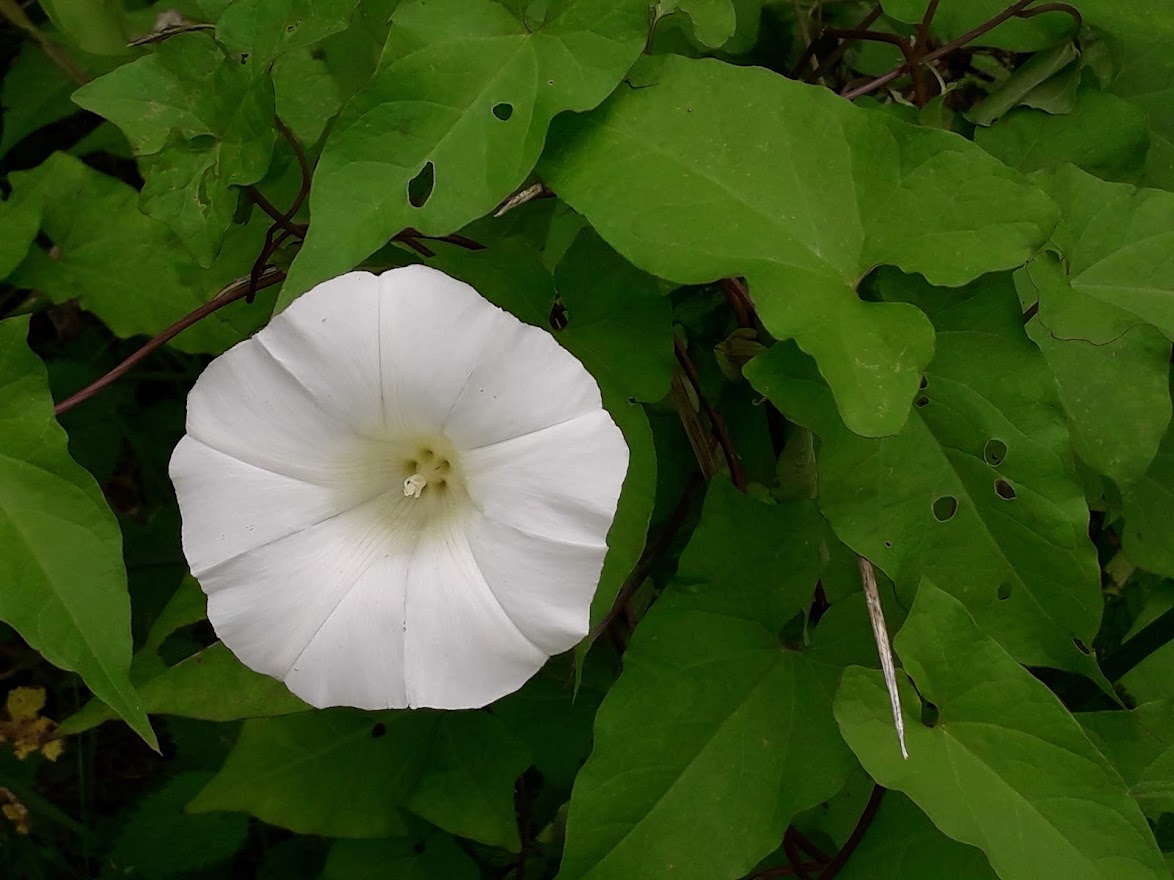
I always thought this was called ‘Convolvulus’, but in researching this I found the familiar plant with white trumpet shaped flowers and heart shaped leaves, is actually called ‘Calystegia sepium’. Whilst it is related to convolvulus, and they share many characteristics, doesn’t actually bear that name, so I will refer to it by its colloquial name, bindweed.
I’m sure the beautiful white flowers are familiar to many of us, either from seeing it grow wild or maybe because we’ve had to deal with it encroaching on our gardens. Whilst the flower is attractive, the plant is very prolific, which may not be a problem in a wild area, but it lives up to its name, as it winds itself around other plants, choking them; thus, destroying less resilient competitors.
Like most plants we would call weeds (I always think weeds are just plants growing in unwelcome places), it is well designed for survival. It spreads rampantly, growing up existing structures and plants, and across the ground seeking out new spaces and other plants to smother. It grows from an underground system of rhizomes (underground stems) and deep roots, and even a small piece of broken off root can grow another plant. If you try to pull it up, it will most likely break at the base of the stem and leave the root in place, thus preserving itself, whilst leaving us with a false sense of success at having removed it.
It struck me that this is like some of our thoughts, which can often be deeply based, especially where they started to grow from things in our early years. Without us even noticing, as it happens under the surface, they can develop a strong root system in our thinking. The shoots that come up from them sometimes have beautiful parts which we and others briefly admire, yet they also tend to spread into other areas of our lives and take over. Noticing this, we sometimes seek to contain them and pull some bits off, yet if the root remains, the plant is ever present and will return to continue choking other growth.
Of course, if a weed is just a plant that is not welcome, we may welcome it and thus it becomes just a plant; that is a choice a gardener makes, and rightly so. If you love your bindweed, then you can allow it to run rampant. Although neighbouring gardeners might not appreciate its tendency to invade, and so it may create conflict between you, it is your decision.
I would suggest only this, don’t let the plants become the gardeners, and take away your choices. Get to know the plants you are growing and choose them rather than letting them grow by happenstance. There are so many things that can be grown, even in the most impoverished of soils and smallest of spaces; in fact, there are a wonderful variety of plants that thrive in just these conditions, yet I suspect you are neither small nor impoverished by nature!
Why let the bindweed bind you – look out for out it and get the help to root it out, so that you can have a garden that gives you joy, and reflects the wonder that you are now, not allowing things that have rooted in the past, to drown out the present!

 Tales of the Universe