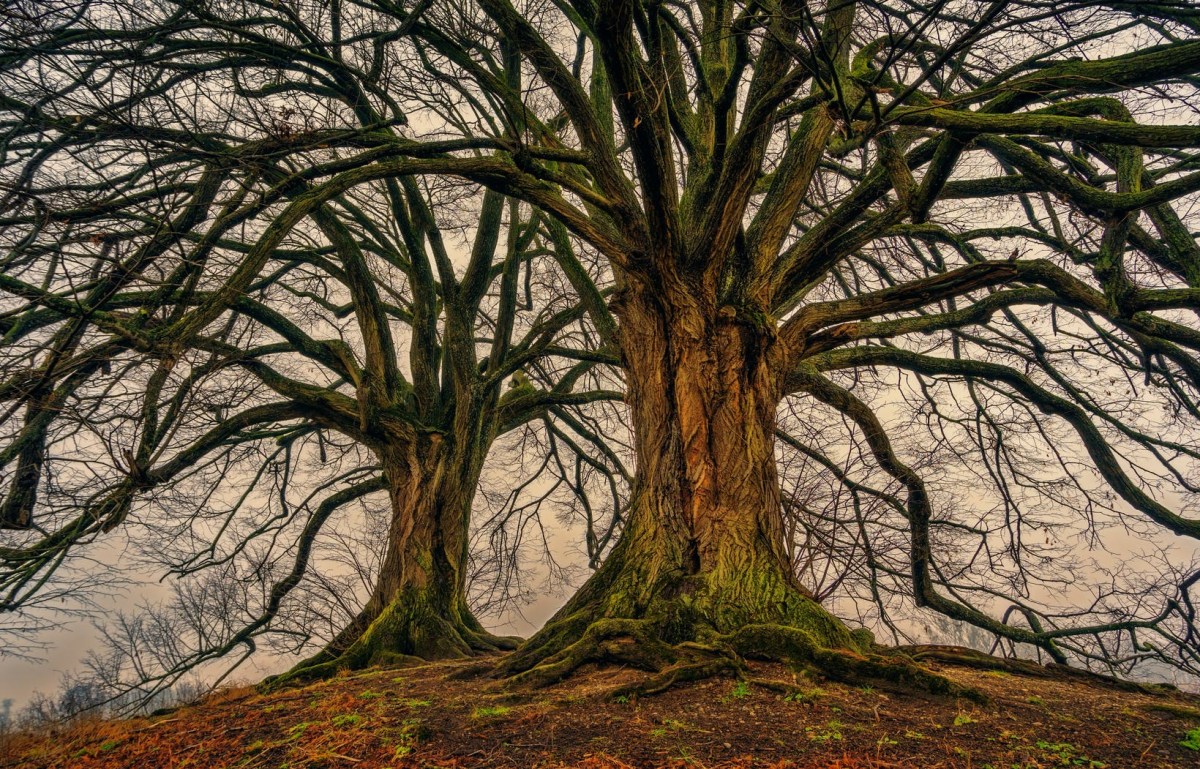
Like trees we have an outer form which interacts with the world around it, providing us and the world with many benefits. Not all trees provide the same benefits, however, here are just few of those they can:
- helping to balance our climate by taking in carbon dioxide & producing oxygen,
- bringing beauty through its form, and/or flowers
- bearing fruit that can provide nourishment for us and/or other creatures
- providing wood which we and other creatures use to build with or make things from
- providing shelter
- acting as a home for a myriad of creatures
- nourishing the ground around with leaves that drop and decay – even their wood ultimately doing this when its ‘usefulness’ is over
Their outer form gives us so much but, like us, trees would not be able to do these things without their inner self – the sap that flows inside them. Nutrients that are taken in, through root or leaf, are distributed throughout their structure, or body, invisibly most of the time.
If they grow in a situation where the necessary nourishment is not available, or is contaminated, they do not flourish and eventually will die.
We too have an inner self that, like roots, draws in nourishment and distributes it, but where we have those roots, where we draw nourishment from, varies.
As far as we’re aware, unlike trees, we not only have a physical form; we are sentient, we need not only nourishment for our bodies, but also for our thinking, choosing, feeling, knowing selves. Maybe trees have that too, but we have little ability to see or understand it, however, we do have the ability to notice that in our selves.
Like trees, if our roots are shallow, or are drawing nourishment from somewhere that gives little that is positive, then our whole structure is at risk. Risk either from lack of strong growth, or through susceptibility to disease, all of which also make us more prone to the elements around us, as trees can be damaged or blown down by strong winds.
Trees can live for hundreds of years, and reach extraordinary heights and sizes, but they stay rooted to the spot in which they grew; only if it gives them what they need, do they flourish.
Like trees, the longer we stay in one spot, the harder it can tend to be to uproot ourselves and move, but trees soon reach a point where being moved is not an option for them, and even in their youth, they rely on others to move them if they are to move.
We can move ourselves, although sadly we seem often to place restrictions on each other about choices in that regard, rendering each other more like trees, in a physical sense, than we are meant to be.
Our form is different than a tree in that we are not at the mercy of the ground in which first start to grow. Even if we have only small choices about our physical location, throughout our lives we have choices about how deeply rooted we become, and into what.
We do not need to move our bodies to move our deepest roots. We have choices about where we draw our nourishment and inner strength from, and we can know it, and we can change it.
There are many kinds of trees, as there are many kinds of us. Maybe we are more like aspen trees than we realise – in that whilst on the outside we appear to be separate and individual, in fact we are all connected, from one source. Maybe we share roots that even we don’t see, and we’re not made to be as separate as we think we need to be for survival. Perhaps that is a meditation for another day.
We are like trees, and we are not like trees but, as I find is true in so many ways, there are messages in nature that echo in our own, sentient lives. Not rules, but whispered truths, about how we are made and how we too can flourish and be free in our current forms, wherever we are.
I love the passage in Victor Frankel’s book, ‘Man’s Search For Meaning’, about a girl who was imprisoned in a concentration camp and soon to die:
“This young woman knew that she would die in the next few days. But when I talked to her, she was cheerful in spite of this knowledge. “I am grateful that fate has hit me so hard” she told me. “In my former life I was spoiled and did not take spiritual accomplishment seriously.” Pointing through the window of the hut she said, “This tree here is the only friend I have in my loneliness.” Through the window she could see just one branch of a chestnut tree, and on the branch were two blossoms. “I often talk to this tree,” she said to me. I was startled and didn’t quite know how to take her words. Was she delirious? Did she have occasional hallucinations? Anxiously I asked her if the tree replied. “Yes.” What did it say to her? She answered, “It said to me ‘I am here – I am here – I am life, eternal life.’”
Life is all around us, and it whispers it’s ageless and timeless truth to us that we are part of it, as is every tree, root, and flower. Life is in us, our constant companion, and we can drink from it and find joy, even in death.
Share D’All
January 2022

 Tales of the Universe