The City

All resemblence to any actual city is purely accidental, but the process may be familiar.

There was once a city – renowned far and wide for its beauty, riches, and hospitality. Many visited it to share in its beauty and resources, to trade and to enjoy the warm welcome of its people; in doing so they brought gifts and ideas which enriched its culture and caused it to flourish and grow.

One day Fear came to visit. No-one is sure exactly when or how, as they did not recognise it for what it was, and so they entertained it without thought or understanding.

Fear basked in the lack of recognition and grew, so that the people began to see things differently, for that is the gift of Fear.

Rather than enjoy and share what each had, the people started to fear the loss of it. Whereas they had celebrated the city’s wonderful diversity, and its ever-changing beauty, they began to worry that they could not control that change and to see change as loss.

As they looked outside the city at other lands and saw there was want and unhappiness. Fear whispered to their hearts that it was because there was not enough, so they started to see their resources as limited and believe they must hold onto and protect them.

Rather than welcome visitors and the ideas that came with them, the people started to pay more attention to what visitors took rather than what they brought to the city. Some started to openly share their perception that nothing anyone could bring would be enough to replace what they were taking by merely being there, and over time Fear’s companion Resentment also took root.

With Fear and Resentment now firmly established, yet still unrecognised for what they were, the people chose leaders who promised to give back control and protect what was rightly theirs. They were comfortable with the new way of looking at the world, it was no longer new, it was familiar.  

To tackle the problems Fear had created, at first the leaders dug a moat around the city and set up ports to manage visitors. However, as nature embraced the new moat, it became a beautiful addition to the landscape, and it started to attract more visitors; the leaders found it impossible to control the number of boats crossing the moat. Fear grew as they felt less and less in control and as its power increased. It whispered the idea that the visitors were a threat and soon Fear and Resentment together had alienated the people from love and left them only with vulnerability; they clamoured for action.

So, the leaders built a wall to make them safe, not realising each stone in it was created from Fear. They reduced the ease of trading and made only a few gates which were guarded so that they felt firmly in control. They turned most people away who tried to enter.

Those who were turned away felt the loss. They felt hurt and rejected; they did not understand what they had done to cause it. The pain was so unpleasant that over time to manage the pain many covered it with anger and sometimes violence. They shouted their pleas to be let in at the gates, and when there was no response, they threw stones of desperation and anger at the walls. The people inside the city felt under siege; they closed off all but one of the gates and increased the guards.

So it was that the people in the city became cut off from the rest of the world, but also from the very things that had made the city flourish. The people within the city soon found that they had lost much of what had made their lives rich and beautiful, and over time the want and unhappiness they had feared most developed within their walls.

They had not realised that the enemy within had caused the enemy outside and they entertained it still.


Share D’All

The Triplets

A story about balance and the importance of seeing the whole not just the parts.

A tiny egg lay waiting inside a mother to be. When its chance to become a baby came along it was so overcome with joy at the prospect of starting a new life, that it split into three, and so one life became three and they began to grow.

On the day when they were born, their parents were only expecting two babies. They were extremely excited to have three, but they didn’t have names for them all so, as they seemed identical and they needed to tell them apart, they referred to them as One, Two and Three.

One had come out first, shooting out at speed with all arms and legs flailing; Two burst forth with a loud cry just, it seemed, to make sure to be noticed; and Three slid out quietly and peacefully, content with the world from the outset.

When the nurse heard their number names, she smiled and, touching the head of each she said ‘Ib (1), Ob (2) and Peb (3)’, as this was the language of her home. Their parents looked at each other and smiled; they liked the names and so that is who they became – Ib, Ob and Peb.

As babies it was clear that they belonged together. They were at their happiest when they could hear and see each other close by, and they slept most soundly when, in one cot, they were cuddled up together.

Their parents got a big mirror, so they could see themselves together, and they loved looking at how alike they were. When they learned to talk, they would proudly say, “We are one in three”, as their parents had told them the story of how they came about.

As from the moment they were born, they looked the same, but in other ways were quite different:

Ib’s interest in, and enjoyment of, things of the body was strong.  Ib was always active; the first to walk and run. Ib loved tasty food and had an unending appetite for sweets, crisps, and cakes. Ib loved to do sports, be with others and look good; being very bothered about fashion and fitting in. Ib loved excitement and was the most confident; always ready to try new things and take risks.

Ob’s interest in, and enjoyment of, things of the mind was strong. Ob was the first to learn to read and write; and then read and made-up stories all the time. Ob loved the computer and looking things up and playing challenging games. Ob loved puzzles, playing detective, and knowing things. Ob was also cautious and sometimes anxious; quick to spot dangers and keen to avoid them.

Peb’s interest in, and enjoyment of love, life, and the world, was strong. Peb was always patient, loving, and gentle; the first to share a cuddle and give help. Peb took time and savoured everything; was amazed by nature and never seemed to tire of wondering at its beauty or wanting to hear about the lives of others. Peb loved to sit, listen and enjoy; seeming more happy to just be rather than wanting to make things happen. Peb could never be described as quick to act, or loud, but was always keen to experience every moment to the full.

Whatever else they did in the day, they always played and talked together. They shared a room with beds in sight of each other. Each morning they would hug then share their plans for the day; each night they sat quietly together and talked about how their day had been before saying goodnight with a last hug and settling down to sleep.

As they got older however, things began to change.

Ib’s group of friends grew bigger and Ib became distracted by the sheer range of exciting things there were to do and enjoy. Now rarely at home, Ib not only did things during the day, but sometimes went on sleepovers and was not there at night, or in the morning, to spend time with the others.

“I want a room by myself” said Ib, “then I can have friends to sleep over, and I can make the room look nice, as these two don’t like the same things as me.”

“Suits me” said Ob, who had also found more and more things to be interested in and know about.

Ob was fascinated with what was happening in the world, and there seemed to be so much to form and share opinions about. Ob also loved technology and using it find things out or to play games and be in touch with friends even when they were not there; getting tetchy with the other two if they interrupted.  

Peb’s favourite places were either outside, exploring the world, listening to the birds, and smiling at the sunset, or at home with the others, hearing about their lives and what they were doing. It was obvious that separate rooms were what the others wanted and Peb, as always, was keen for them to be happy said quietly,

“Well okay, as long as I can see the garden through my window and we have three seats, and our mirror, so that we can still look at it and be together.”

So, each was given a separate room. Over time the practice of starting and finishing the day together drifted away and was forgotten by everyone except Peb, who always waited quietly by the mirror just in case. They stopped doing things together and Ib and Ob went their separate ways. Things started to change even more.

All the exercise meant Ib’s body became fit and agile, but Ib’s love of sweets and snacks meant that whilst it looked strong it did not always look healthy. Ib started to get ill more often and get dull and spotty skin. Ib’s desire to fit in and have excitement, and lack of thinking about risk, meant Ib would do anything for a laugh, or to fit in, and sometimes ended up getting in trouble and doing things that meant Ib, or others, sometimes got hurt.

Ob, on the other hand, became very clever but quite anxious. Ob found out about lots of things and could tell you interesting facts about practically anything, but Ob also then tended to worry about what might happen and got very cross and frustrated when things didn’t go as they should. Ob ate snacks to feel better and rarely went outdoors; the lack of exercise and anxiety took its toll and Ob became pale and podgy.

Peb could see what was happening to Ib and Ob but was never one to try to push the others around so was powerless to help. Peb more and more listless and sad looking but also slept less well, without the others nearby. As the others no longer wanted to explore outside Peb lost energy and took less exercise so that the weight started to pile on. The lack of closeness, discussion and sharing of experiences meant Peb became quieter and quieter and worry lines began to appear. Peb started to look older.

One afternoon Ib had come home with a torn uniform, a bruised face and a note from the school asking to see their parents. Ib had joined in with some bad behaviour and got into a fight. Their parents asked them all to sit down and talk about how they could help Ib, but Ob, irritable as usual, did not want to:

“Why would I help a stupid person! It’s nothing to do with me!” shouted Ob “Ib’s just making us all look bad by being too stupid to realise when to say no. I wish we didn’t look the same, it’s embarrassing!”

“You think you are so clever Ob, but really you aren’t!” retorted Ib angrily. “You’re so worried about everything that you never come out of your room – look how fat and ill you look. I’m embarrassed by being anything to do with you!”.

“… But we are one in three!” cried Peb, “we mustn’t be embarrassed by each other.”

Both Ib and Ob turned on Peb, angry at each other but unable to separate that out they let rip:

“What do you know?” said Ob unkindly, “You just sit there grinning …”

“Like a stupid fat lump!” added Ib cruelly, “You are embarrassing too!”

Peb looked at them both completely shocked.  Ib and Ob stormed off and shut themselves in their rooms.  After a moment Peb stood up, and, as tears started streaming, went outside to calm down.

Once the shock of what had happened passed, both Ib and Ob realised how unkind they had been, and soon their parents could hear that all three of them, in their own places, were sobbing.

Wisely they gave them time for the crying to subside and for each to be still for a while – so that each had a chance to recognise what they were feeling, and then gently went and got each of them and sat them down in Peb’s room in the seats by the mirror.

“Is this who you want to be?” they asked, then waited.

Peb looked at the others, whose faces were so familiar but now looking down and shameful, then got up and looked in the mirror.

Peb could see the truth. “It’s true” Peb said quietly, “my body is not healthy, and I have not given my brain enough challenge … and now I look old, and I feel sad.” Tears flowed down Peb’s face. “That isn’t who I want to be. In my heart I know we are still three in one and there I am happy.” Peb tried to smile at the others through the tears, but they were still looking down.

After a while, Ib stood up next to Peb. Ib’s head was heavy with shame and at first was only able to glance in the mirror.  “My body looks torn and bruised … and I feel sick for being so stupid and unkind” a sob slipped out, “I am sorry … it isn’t who I mean to be…” Tears cascaded down again. hand.

At this moment Ob stood up and squeezed into place in between them – looking reluctantly in the mirror. “I look ill … I look like a sick idiot … who knows lots of things but has forgotten what is important. That is not who I want to be … and I am sorry too.”

All at once they were all saying ‘sorry’ to each other and hugging and crying a bit more…

When the tears and apologies were over, their parents helped them talk about how they could help each other be who they did want to be.

“If you want to lose weight Peb, or not be stuck indoors Ob  – I can help you with that” said Ib, “we can do exercise together and we could all do with working out better food to eat … I’d love that.”  Peb and Ob both agreed that would really help and be fun to do together.

“… and I don’t want to be stupid” continued Ib, “I don’t want to be bossed around, but I do need to learn how to tell what is, and isn’t, a good idea … and how to tell a good friend from a bad one.”

“I could help with that” said Ob, “there are lots of things we can do to help you think things through if you like.”

“… and I don’t want to be unkind and anxious,” continued Ob “…can you help with that Peb as you are the kindest, most relaxed person I know?”

“I need that too” agreed Ib meekly.

“Thank you” said Peb quietly, “…maybe if we sit together and talk, like we used to, I can help you both relax and find your kindness …and notice when something does not feel right inside. That would make me happy too.”

“…and Ob, there are things I would like to learn about too and get my brain going.” added Peb, smiling.

They all looked in the mirror again, not quite as identical as they once were, but back together again.

“We are One in Three” they said – for the first time realising that each One of them brought a different thing, and that it was when they each paid attention to all Three of the things they brought, that each of them were happy and whole. The Three needed each One and each One needed the Three.

That of course was not the end … but another new start.

From that day on Ib, Ob and Peb never forgot what they had understood. Even though their lives changed a lot as the years went by, they always made time to be together as often as they could and each of them remembered what they had learned from each other.

They all made sure to look after their bodies by exercising and eating healthily; to use their minds to learn new things and find out what works and give time to what they called their ‘inner Peb’, their spirit; time to just be, space to notice their feelings, to take time to sit, look, listen, to make opportunities to enjoy amazing and beautiful things and talk to and help, each other.

When they were fully grown their favourite thing was to go for a walk together, taking turns to choose where and asking Ob to suggest a subject they could find out about. When they set out Ib would make sure they walked fast and got good exercise to keep them fit: as they walked, they would discuss the subject Ob had chosen and then have fun with brain teasers and riddles, until Peb would point out that they had arrived at a lovely spot, or where there was a lovely view.

Then they would stop and sit together. Sometimes they would hold hands, but always they would just sit and look for a while, relaxing and taking it in. When the time was right, Peb would smile and start them off and they would take time to listen to each other’s feelings, joys, and challenges. When life was hard, they would help each other and hold each other close, and when it was good, they’d smile and laugh… and sometimes even dance.

… and so, the One continued as three, happily separate and together until the day it was time for their journey to end. Then, as they left their bodies, their souls spun back together, returning once again to being One, full of joy and ready for a new adventure.


Share D’All ©

Life leaving?

In memory of my sister – Dr Jacqueline (Jackie) Meredith:

My sister died a few days ago,
I was with her in that moment.
It was not loud or momentous,
It was peaceful.
Like life stepping away quietly.
Her body remained.
It stayed with us
Whilst we went through
The business of her parting,
But it was clear she was not there.
She was not her body.
Her life force was no longer there.
It had stepped away.
I have sought to find her,
Her energy, her spirit.
I can feel warmth
In my memories of her,
Pleasure in the memories
Others share of her.
They make me smile,
But also make me sad,
For they are memories
Of life that was.
I sought to find her
But to no avail,
Until I stopped and found
The life force that’s in me,
The life force that’s in all of us.
It is the same.
Quietly, yet somehow
With amazing energy.
Life fills our spaces.
Our brains and bodies
Mould it into
Our experiences,
Our present journey.
Yet, at this moment of separation
It becomes clear,  
We are not our bodies.
Life itself somehow
Is formless;
A force, an energy.
We know energy transforms,
It does not die, or end.
Now I feel it in me,
That same energy,
That was her life-force
Resonating in and all around me.
Here, where each,
All, or any of us are,
This is where Life continues.

© Share D’All
 November 2022

Space

Is space ‘the final frontier’ or maybe something closer to home?

As I have said many times before – I am certainly not an expert in any form of science – and to be honest, whether it is looking up into space and the nature of the universe, or down into the smallest building blocks from which all matter is formed (including us), I find my mind largely boggled. I also find the language that the wonderful people who look into of many of things use to explain what they have learned, often loses me!

However, despite my limitations, I do know that whether you look up or down, the thing you will find a lot is ‘space’. We use the very word ‘space’ to describe the nature of the universe and a large part of the make-up of every atom is space!

Of course, we aren’t completely certain what the nature of this ‘space’ is. There are things that are not visible to us, and plenty of formless things that we don’t yet understand, but maybe that doesn’t matter, because the thing that strikes me is how critical space is to everything we know.

I think this is one of those messages in life we need to pay attention to – space is important to us!

Maybe it’s looking down to the make-up of an atom that helps us most to understand it. At the heart of an atom is its nucleus, its core. Around its core there is space and within this space energy dances around… protons, neutrons, electrons (those are the ones I can name) – they need space to dance in, but they dance in different ways in different atoms and situations! That is my over simplified way of looking at it anyway.

We often look for the dance in our lives, the joy, to come from things around us, and it is true that we can get a lot of enjoyment from them. However, we often get so absorbed in this pursuit that we overlook the fact that the energy that holds us together is in our core, not outside us, and it needs space for those inner resources to dance and release their energy.  

If we don’t make time for space in our lives, then our whole systems are in danger of collapsing in on themselves.

So, make space in your life and it is my experience that you will find your core and it is stronger than you think. Make time to look in sometimes and experience the space that is within you and the inner resources that dance within it. They are at the very core of you, and they do not depend upon what is outside you. It is your inner resources that are best at bringing joy and energy into your life… focus on your inner space and you will feel them dance!

Power or Strength

We live in a world where desiring power is considered admirable, where wanting to remain in power seems an understandable excuse for saying and doing anything, and where taking power is considered by some an acceptable objective. Does what is happening right now in our world perhaps give us pause for thought?

Looking through the clouded eyes
That many use to view this world,
Power is might;
To take control
To cede things
To our will.
We would not
Describe power
As overcoming,
For that seems weak,
Power is too often
Used over, not in.

Yet the desire to have power
Is born out of fearing its lack,
Not from might.
It’s a veneer.
The more brutal
It’s actions
The greater
Chasm of fear
It’s there to conceal.
A mere disguise,
A self-deception,
Emptiness inside.

Looking through less fearful eyes
At ourselves and also others,
We see strength
Is not the same.
It does not seek
To control,
To take away
Another’s rights
Another’s choices.
It’s not unkind
It does not demand
It only stands firm.

Strength is seen in a response
Not in an initiation
It is born
From certainty.
True strength is found
In challenge,
Even in loss.
No hole inside.
There may be pain but
There’s also love.
Strength is found within,
Power is without.

Share D’All
April 2022

Walking Without Words

Recovering from a recent bought of pneumonia I have found at the moment I am not able to walk anywhere nearly as fast as I usually can; this has coincided with reading a book by Eckhart Tolle and these things together have introduced some new joys not regularly experienced in the past.

I have noticed just how often the constant stream of words that are my thoughts, pull me away from experiencing life in each present moment, so I have decided to try walking without words. When words come to mind, I just let them drift away and choose not to entertain them; instead I focus on something I can experience with my five senses. These are some things I have noticed.

There is so much beauty, even in unexpected and surprising places.

  • Rather than just a glancing recognition as you pass, have you stopped and looked at the wonderful shapes and colours in flowers and blossoms, or breathed in to smell the scent of those that have it?
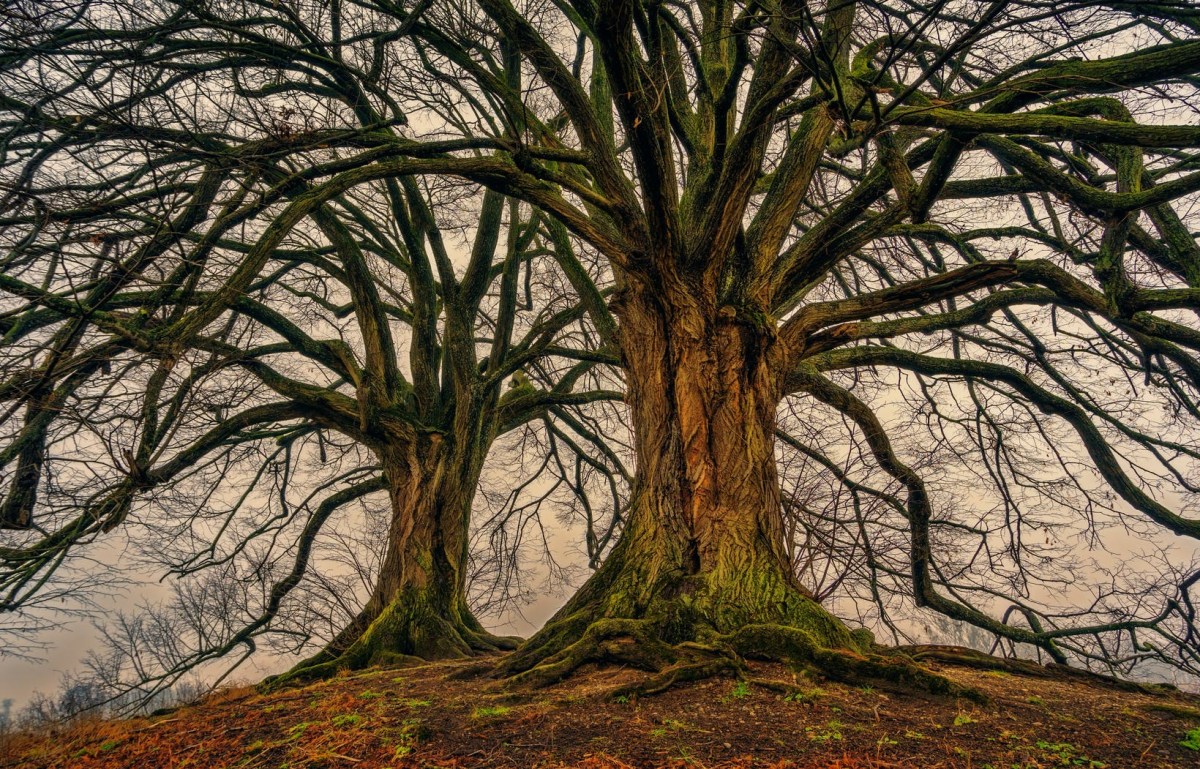
  • Have you ever really looked at the amazing shapes tree trunks make (best seen before they are fully in leaf) – how they twirl and twist and reach out; or taken in the fascinating texture of many of them, maybe even touched it to feel the roughness or smoothness of it?
  • Have you noticed that even in amongst the decay, life breaks through – moss in between the bricks, tiny leaves in cracks, plants breaking through concrete, some with flowers, some without?
  • Have you noticed the colours in brick and stone, or seen how different colours of dust, earth and sand sit in the cracks and create contrast which emphasises intriguing patterns?
  • Have you noticed clouds? Have you watched how they move and change over time or simply noticed their amazing puffiness against the blue sky?
  • Have you felt and smelled the dampness in the air as rain approaches?
  • Have you marvelled at the stunning colours of a sunset or watched the shade of light shift, heralding dawn or simply a change in weather?
  • Have you stopped and listened for birds and let their song bring joy to your heart?
  • Have you heard birdsong nearby as yet unseen, then stood still long enough for your eyes to pick them out and see them with their wonderful shapes and colours, opening their beaks to trill?
  • Have you seen the amazingly varied, and similar, structures, shapes, and colours in the things that mankind has created and marvelled at the ingenuity and creativity, or how time has changed it to a different kind of beauty?

I won’t go on … go for a slow walk without words and just use your senses to experience what is around you. It is ‘mindfulness’, but sometimes I find the word misleading, actually it is moving past your mind, which is often pre-occupied with judging, planning, scanning, and processing – taking you away from what is to what might be, was, or could be… it is just walking without words.

I’ve also noticed there is something more than mere beauty in experiencing things this way, something that touches me more deeply than just admiration; something that touches a joy that is in me and connects with it.

Seeing, experiencing, things this way gives me so much more than looking at a picture of them; it’s like the life in me recognising the life in something else and when they connect joy is made, like a chemical reaction.

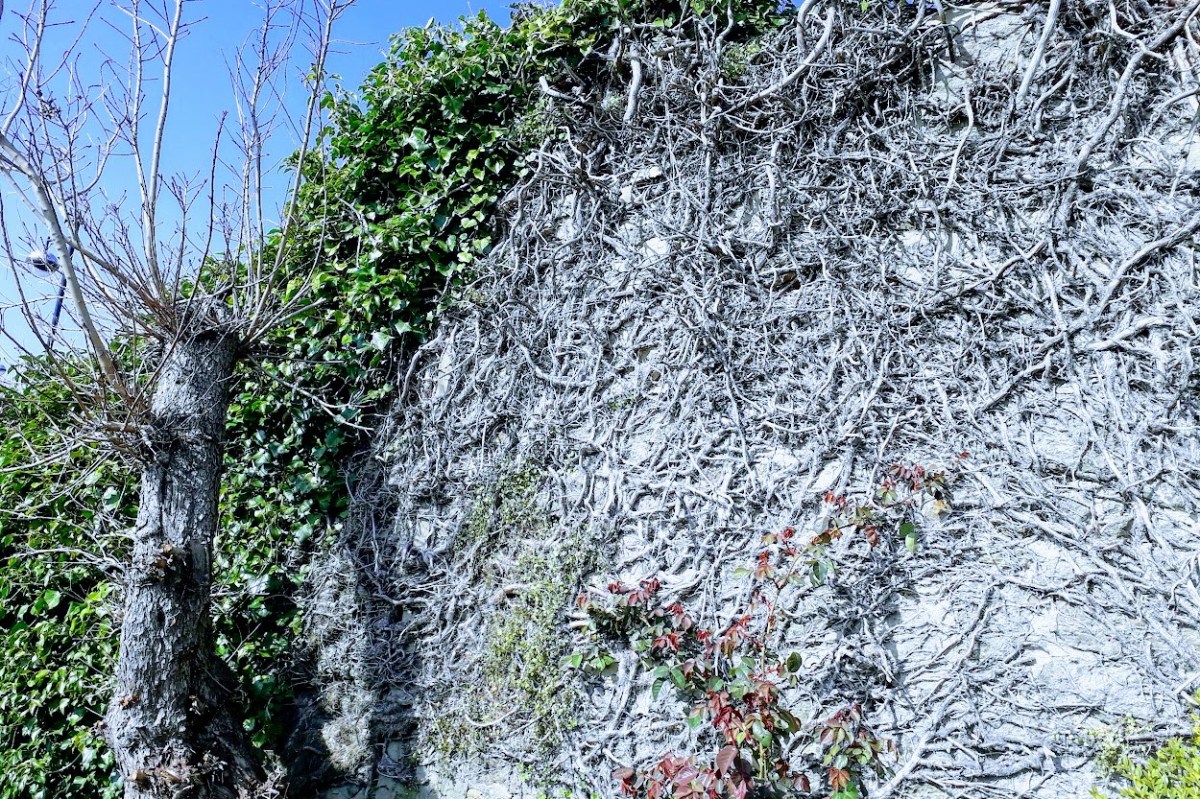
I took the picture above because I had that feeling being there, the bare roots on the wall drew me in and the tree, despite having been drastically curtailed, was pushing out new shoots into the sky, but the picture in no way contains what I experienced looking at it at the time.

I completely recognise that I am not a good photographer, and someone with the skills and equipment I lack could do a far better job, BUT whilst beauty can be captured in a picture it is rare, if not impossible, to capture the life that was being experienced in the interaction. We can take a snapshot of it, and it may inspire memories, thoughts or reactions which can be very powerful, but life is only experienced in the moment and that is the point at which it is readily available to us all.

So, I recommend – take all the opportunities you can to enjoy the richness of life in the moment; after all that is where life is and it is constantly moving on, yet constantly there, because our life moves with it, even though a lot of the time we are too distracted by focusing elsewhere to notice!

Think Upon A Flower

It may be many things …

A beautiful creation that brings joy, the source of a wonderful smell, a seed maker bringing promise of a future flower, a nectar provider, the forerunner to a delicious fruit or a nutritious seed or vegetable, a lovely colour or a form that inspires art and creativity in us, an expression of love when given, an example of an intricate mathematical pattern… or a million more possibilities …

We may see it as a single thing,
We may even cut it and treasure it as a single thing… or part of an arrangement,
It is a flower after all …
… but it is not just a flower.
It is an individual expression of something bigger…
It is part of a plant,
And that plant is part of nature,
And nature is part of our world,
And our world is part of our solar system,
And our solar system is part of our galaxy,
And our galaxy is part of our universe,
And maybe … although it is beyond our view… our universe is one of many,
… or part of something bigger, beyond our view.

Then looking down, instead of up,
That same flower
It is made of parts;
Petals, stamens, nectar, pollen…
Each is made of cells,
They may be different,
Yet they’re all made of the same stuff …
Configured similarly,
And also, differently,
Each atom, each subatomic particle,
Moving, to its own beat.
It is all … energy.
Energy that never dies,
Just changes form.

Think upon a flower.
Think upon you.
Think upon each of us.

Share D’All
January 2022

Trees

Trees are magnificent. It’s difficult to describe how important they are; how many benefits they bring to our physical world and our mental health. They are well worth our time and attention. What can we learn from them?

Like trees we have an outer form which interacts with the world around it, providing us and the world with many benefits. Not all trees provide the same benefits, however, here are just few of those they can:

  • helping to balance our climate by taking in carbon dioxide & producing oxygen,
  • bringing beauty through its form, and/or flowers
  • bearing fruit that can provide nourishment for us and/or other creatures
  • providing wood which we and other creatures use to build with or make things from
  • providing shelter
  • acting as a home for a myriad of creatures
  • nourishing the ground around with leaves that drop and decay – even their wood ultimately doing this when its ‘usefulness’ is over

Their outer form gives us so much but, like us, trees would not be able to do these things without their inner self – the sap that flows inside them. Nutrients that are taken in, through root or leaf, are distributed throughout their structure, or body, invisibly most of the time.

If they grow in a situation where the necessary nourishment is not available, or is contaminated, they do not flourish and eventually will die.

We too have an inner self that, like roots, draws in nourishment and distributes it, but where we have those roots, where we draw nourishment from, varies.

As far as we’re aware, unlike trees, we not only have a physical form; we are sentient, we need not only nourishment for our bodies, but also for our thinking, choosing, feeling, knowing selves. Maybe trees have that too, but we have little ability to see or understand it, however, we do have the ability to notice that in our selves.

Like trees, if our roots are shallow, or are drawing nourishment from somewhere that gives little that is positive, then our whole structure is at risk. Risk either from lack of strong growth, or through susceptibility to disease, all of which also make us more prone to the elements around us, as trees can be damaged or blown down by strong winds.

Trees can live for hundreds of years, and reach extraordinary heights and sizes, but they stay rooted to the spot in which they grew; only if it gives them what they need, do they flourish.  

Like trees, the longer we stay in one spot, the harder it can tend to be to uproot ourselves and move, but trees soon reach a point where being moved is not an option for them, and even in their youth, they rely on others to move them if they are to move.

We can move ourselves, although sadly we seem often to place restrictions on each other about choices in that regard, rendering each other more like trees, in a physical sense, than we are meant to be.  

Our form is different than a tree in that we are not at the mercy of the ground in which first start to grow. Even if we have only small choices about our physical location, throughout our lives we have choices about how deeply rooted we become, and into what.

We do not need to move our bodies to move our deepest roots. We have choices about where we draw our nourishment and inner strength from, and we can know it, and we can change it.

There are many kinds of trees, as there are many kinds of us. Maybe we are more like aspen trees than we realise – in that whilst on the outside we appear to be separate and individual, in fact we are all connected, from one source. Maybe we share roots that even we don’t see, and we’re not made to be as separate as we think we need to be for survival. Perhaps that is a meditation for another day.

We are like trees, and we are not like trees but, as I find is true in so many ways, there are messages in nature that echo in our own, sentient lives. Not rules, but whispered truths, about how we are made and how we too can flourish and be free in our current forms, wherever we are.

I love the passage in Victor Frankel’s book, ‘Man’s Search For Meaning’, about a girl who was imprisoned in a concentration camp and soon to die:

“This young woman knew that she would die in the next few days. But when I talked to her, she was cheerful in spite of this knowledge. “I am grateful that fate has hit me so hard” she told me. “In my former life I was spoiled and did not take spiritual accomplishment seriously.” Pointing through the window of the hut she said, “This tree here is the only friend I have in my loneliness.” Through the window she could see just one branch of a chestnut tree, and on the branch were two blossoms. “I often talk to this tree,” she said to me. I was startled and didn’t quite know how to take her words. Was she delirious? Did she have occasional hallucinations? Anxiously I asked her if the tree replied. “Yes.” What did it say to her? She answered, “It said to me ‘I am here – I am here – I am life, eternal life.’”

Life is all around us, and it whispers it’s ageless and timeless truth to us that we are part of it, as is every tree, root, and flower. Life is in us, our constant companion, and we can drink from it and find joy, even in death.


Share D’All
January 2022

Finding Joy

You may have heard of ‘old souls’ and have maybe met some, yet many of us are young souls … so what if there was a school for young souls?

In was a Monday morning in the school for young souls. When the teacher came to sit with them it was immediately obvious that many were not very happy today, as when souls are happy, they shine, and there was not much shining going on this morning.

There were at least a couple of children who didn’t have any glow at all, and the teacher’s heart went out to them as she knew it was because they were having some difficult experiences that were making them particularly sad.

The little faces looked up at the teacher expectantly.

“Good morning everyone” said the teacher “We’re having a very special visitor coming to be with us today, called Joy…”  The children seemed to glow a little at the prospect of a visitor.

“Joy’s favourite game is a version of ‘hide and seek’ but instead of just hiding, Joy likes to leave clues in all sorts of places about where to look to find her. So today we are going to play the game … it’s called Finding Joy.  I hope you are all up for that?”

The children all nodded their approval; the prospect of playing the game was making most of them shine a little bit more already – except for the few who were sad as they could not find the energy to glow. The teacher smiled at them.

“I know some of you are sad this morning and that may make it harder for you to join in, so I’m going to suggest that any of you who are feeling sad, write down what is making you feel sad today. Then I want you to leave your sadness safely here, so that you can pick it up again if you want to when we are finished… is that okay?”

The children agreed and the teacher’s assistants helped those that needed it, to write down what they were sad about and put in in an envelope with their name on. When they’d finished each child put their envelope in the ‘safe place box’ to pick up later if they wanted to.

When everyone was ready, the teacher told them all how to play ‘Finding Joy’.

“You are all going to have an hour in the ‘Experience World’– you can go anywhere and do whatever you want to, as long as it isn’t hurting others of course. You should know that Joy is sneaky and has made the clues a little tricky to find, but I can give you some hints. The fact is that you are less likely to find clues if you spend your time looking for them; most of the clues are hidden in experiences of all different kinds, so just get fully involved in whatever experience you fancy, have a good time and be kind to each other. When the bell rings we will all come back here and share the clues you found and see if we can all Find Joy”.

“How will we know when we have found a clue?” asked one sensible soul.

“That is a good question.” said the teacher. “When you find a clue some part of you will start feel sort of warm and happy and that will start to show on the outside – like a sort of glow or glimmer at first. You may need to help each other, as sometimes it is easier for someone else to see when you start to glow more quickly than you will, as you might be distracted by what you are doing and not notice.  When you notice you have found a clue, then remember what you were doing at the time, and what it felt like, so that you can tell us all and we can work out together what the clue was. You can write it down or tell someone else if you think you might forget.”

“When we start to glow, do we stop what we are doing?” asked another child, earnestly thinking there was a rule they should follow.

“You can choose,” said the teacher. “You can carry on with what you were doing or go and try something else. There are plenty of clues for all of you so you can find as many, or as few, as you want. This is not a competition for who can find the most – it is a team effort, so it doesn’t matter how few or how many each of you find. If you help each other, between us we are bound to find enough.”

When they were ready the teacher took them to the Experience World – where they could choose any type of activity, or experience, they want in complete safety … like a virtual reality world where experiences feel real, but cannot ultimately harm you.

The little souls spread out, sometimes in pairs and sometimes in little groups, all ready to look out for when each other showed some signs of shining. They all chose quite different things to do with their time in the Experience World. Here are a few of the different choices they made which made them glow:

  • Some found physical things to do like a running, playing football, swimming, or dancing – when they found an activity that they particularly liked they soon began to glow.
    • Some went to a place that was special to them, like the top of a mountain, the seaside, the park, or a river. Some went with their family, others with their friends and others with one special person or even alone. Once there they chose to spent time there doing whatever they liked – just looking at beautiful things and feeling the wind in their face, playing, or having a picnic.
    • Some decided to make something – like a picture, a model, a necklace
    • Some learned to play and instrument
    • Some played a game with friends
    • Some played with a pet
    • Some sat and talked and listened to someone they liked to be with
    • Some did a puzzle or solved a riddle … and some made up their own riddle or puzzle
    • Some read or wrote a story – or both
    • Some sang, and others danced to the tune
    • Some made a present, or drew a picture, for someone special they wanted to say thank you or sorry to.

One sad soul did not know what to do and stood alone for a while. A friend saw how sad they were and went and picked them some flowers. When the friend gave them the flowers, they both started to glow and went off together to find new things to do and glow more.

Another soul was lonely and stood away from the others, not knowing how to join in. A kind soul went and took their hand and they started to glow; together they tried lots of different things, glowing more each time, until they had forgotten there had not always been the best of friends.

When the time was up the teacher, who had been waiting for them, called them back. Every single soul was shining as they sat down to tell the teacher about what they had done and found.

Each had a chance to tell their story and many of the stories included how one of the others had helped them, or noticed them glowing before they themselves had spotted it, as they had been so caught up in what they were doing that they had forgotten to look at whether they were glowing or not.

When they had finished telling their stories one little soul put their hand up to ask a question.

“But how does this help us find Joy?”

“You have already found her!” said the teacher.

“… but where?”

“You found her when you started to shine.” said the teacher. “It is Joy that makes you shine.”

“Ahh…” said all the little souls happily.

“So is Joy everywhere?” asked one soul.

“Joy can be anywhere, but she is not found by looking outside for her – she bubbles up from the inside when you do, or be, something that frees her … something that you ‘enjoy’”.

There was a mumble of understanding around the room. One very observant soul had notice something.

“Teacher I notice that you are shining now – what did you ‘enjoy’?”

“One of the easiest ways to find Joy is to give Joy to someone else – if you can give her to someone else it means you had her there all along” the teacher laughed … and shone even more. “I just had a wonderful day introducing you all to Joy.”

The children were happy too and that day when they went home from school, they were all shining a lot more than when they had arrived … even the teacher.

© Share D’All.
All rights reserved.  2021

Religion

It constantly saddens me that religion, in whatever form it seems to take, too often appears to have at it’s heart a loving God and yet somehow end up with favouritism, rejection, division and oppression… I feel we have missed something important somewhere.

There is much wisdom held within religion,
But its purity 
Has been contaminated,
By the tyranny of judgement,
And its bedfellow, requirement.
They all say God is love,
Yet in love there is no requirement,
Nor a need to prove worthiness,
Or earn acceptance.

Like a drug we’ve cut wisdom with other things,
Made it addictive;
A device to give control.
Thinking it’s too good to be true,
That love can be unconditional.
So we’ve made rejection,
Created sides to pick, and rules to keep.
Love’s gift is freedom, not control,
True wisdom is love.


Share D’All
September 2021